Introduction
On May 22, 2025, Kamino, the largest lending protocol on Solana, officially released its latest version, Kamino Lend V2, on mainnet. Built on V1's robust codebase, it ships five core features, Earn Vaults, the Pro Borrow UI, a modular market layer, margin leverage trading, and RWA integration, offering advanced credit products for both institutional and retail users. This article gives an overview based on the official documentation and the official announcement.
Background of Kamino Lend V2
V1 track record
- Roughly $4 billion in assets under management (AUM): top-tier scale in Solana's lending market since 2023
- 14 security audits plus formal verification: audits by multiple firms including Osec, Certora, Offside Labs and Sec3, plus formal verification by Certora, establishing its reputation as the most robust borrow/lend platform on Solana
- Billions of successful transactions: proven stable operation in a high-TPS environment
Market needs
- Shift toward modularity: DeFi protocols offering modules optimized per function allow flexible combinations tailored to partners and use cases.
- Automated liquidity management: the Automated Liquidity feature described in the official docs dynamically reallocates assets within vaults to support efficient yield
- Institutional features: support for KYC/permissioned markets and RWA integration makes it easier for traditional financial institutions to come on-chain
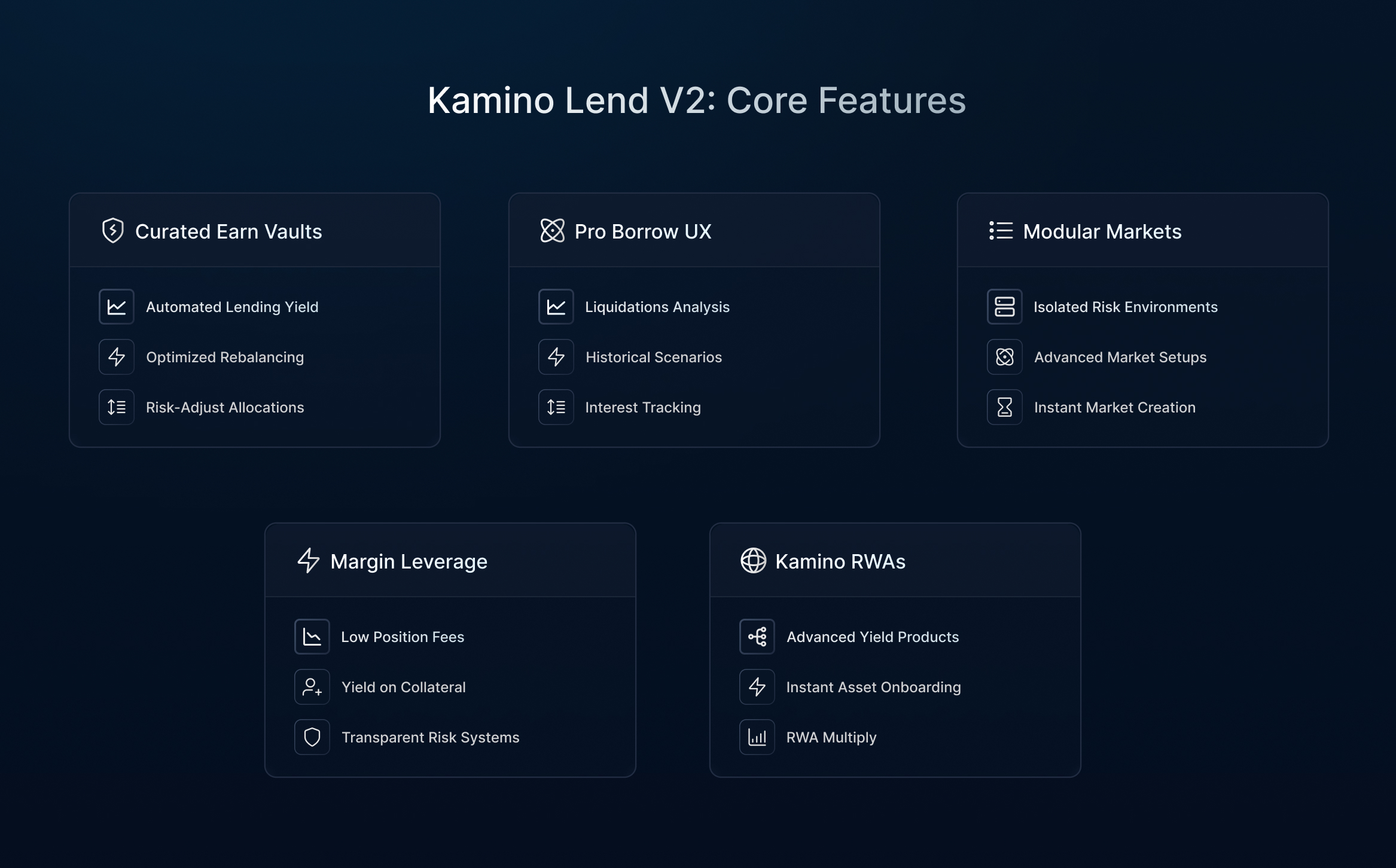
The five core features in detail
1. Earn Vaults (automated lending vaults)
Overview
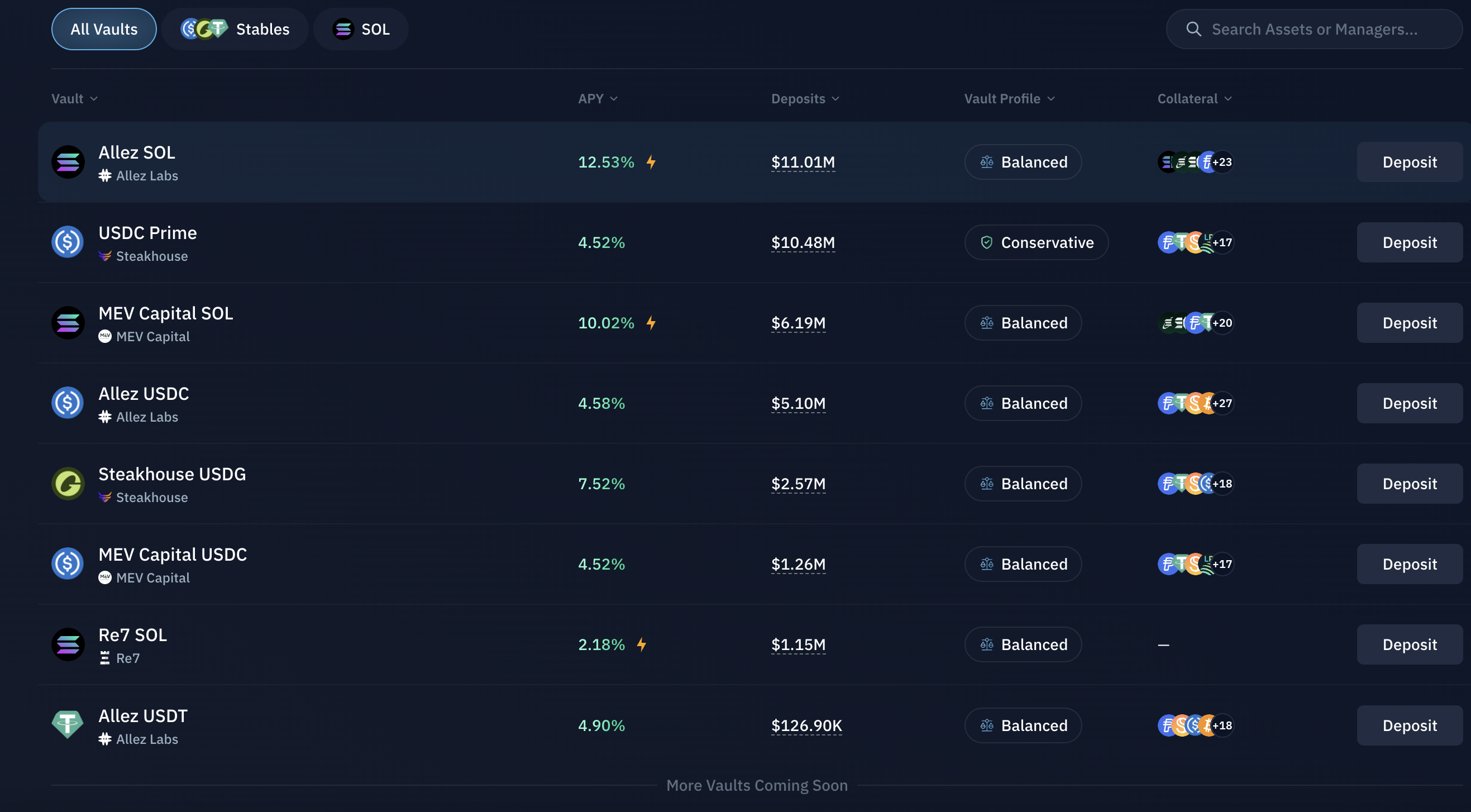
- Automatic allocation by risk tolerance: users pick one of three profiles, conservative, balanced, or aggressive, and the vault's assets are allocated optimally. Each Earn Vault is deployed across various V2 markets according to a strategy set by its vault curator.
- Vault curators: four firms, Steakhouse Financial, Re7 Labs, Allez Labs and MEV Capital, define the asset selection and rebalancing rules for each vault
- Audits: the smart contracts have been audited by Osec, Certora, Offside Labs and Sec3. Audit reports are published on GitHub.
Benefits
- Stable yield: automatic rebalancing in response to market conditions pursues the maximum yield within the chosen risk level
- Simple user experience: just pick a risk tolerance in the UI to start, and all subsequent adjustments are automated
In short, there are vaults set up per risk tolerance, and if you deposit SOL or USDC, the service deploys it across various venues on your behalf.
It seems well suited to people who do not have time to hunt for the best yield opportunities themselves.
https://app.kamino.finance/earn/lend
2. Pro Borrow UX (data-driven loan dashboard)
Main features
- Liquidation risk analysis: analyzes how market movements affect your position
- Scenario analysis: simulates the price impact of past events (FTX, LUNA, the Trump presidential election, etc.)
- Interest breakdown: tracks interest paid, interest received and net interest over time
- LTV history: tracks the LTV history of a position as a time series
More is planned, aiming for a borrowing UX on par with traditional finance.
Use cases
- Institutional users: risk management staff use the dashboard to monitor portfolios
- Retail users: decide the optimal time to borrow while watching their own borrow rate and LTV trends
3. Modular market layer
Architecture
- Modular market infrastructure: leverages the formally verified V1 market codebase
- Instant creation: markets can be created instantly with highly customizable risk parameters tailored to the credit environment
Initial launch partners and markets
| Partner | Product | Leverage | Monthly incentives |
|---|
| Marinade Finance | mSOL Loop | 10x | 165,000 USD (1,150,000 MNDE) |
| Solblaze | bSOL Loop | 7.5x | 44,000 USD (120M BLZE) |
| Sanctum | INF Loop | 4x | 34,000 USD (144 INF) |
| Exponent & Jito | PT Loop | - | 20,000 USD (10,000 JTO) |
| Bonk Inu | Leverage | - | 22,000 USD (1B BONK) |
| …and more, 10 markets in total |
Use cases
- Permissioned / KYC markets
- Fixed-rate borrowing
- Custodial borrowing
- Borrowing against staked SOL
4. Margin leverage trading
Highlights
- Low-cost leverage (2x to 4x) on long-term positions
- One-click leverage powered by Kamino Lend V2
Core features
- Classic trading UI
- Fees far lower than perpetual futures
- Yield on collateral
- Soft liquidation
- Liquidation protection
5. Kamino RWA (real-world asset integration)
Phase 1: the ACRED token
- Issuer: in partnership with Securitize and Steakhouse Financial
- Benefit: flexible leverage strategies using on-chain collateral
Multiple tokenized assets are in preparation to follow ACRED.
New Solana-native, RWA-specific infrastructure is planned for the future.
Security and audits
- V1 core: 14 full audits by multiple firms plus Certora formal verification
- V2 Vaults: pre-release audits by Osec, Certora, Offside Labs and Sec3 completed
- Ongoing audits: quarterly pentests for each new feature
Detailed audit reports are published on GitHub.
User migration and developer support
- Zero migration cost: V1 smart contracts can be used as they are
- Comprehensive documentation: API reference, TypeScript/Go SDKs and CLI sample code
- Open source: issues and PRs welcome on GitHub
Outlook
- More RWA project announcements (multiple tokenized assets in preparation after ACRED)
- Expanded modular market partnerships and additional incentivized markets
- Continued UX improvements and SDK/API expansion
Closing thoughts
Personally, I am looking forward to the introduction of borrowing against stake accounts. Once that lands, picoSOL Multiply positions could be unwound via delayed unstake, which would largely avoid the final hit to returns from slippage.
As for margin leverage trading, I plan to try it out and see how usable it is.
And as an investor, I am simply excited to see RWAs and all sorts of other assets coming on-chain!
For the latest information, check the official documentation and X (@KaminoFinance).
This page is for informational purposes only and does not constitute investment advice, solicitation, or recommendation. The picoSOL token is a liquid staking token (LST) on the Solana network issued and managed by the Singapore-based project Sanctum. We act solely as a validator receiving delegation from picoSOL and are not involved in its issuance or management. There is no offering or solicitation of picoSOL to residents of Japan. Actual returns and prices may fluctuate due to network conditions and other factors, and past performance does not guarantee future results. Additionally, technical risks—such as smart contract vulnerabilities or network outages—may impair asset value. We assume no responsibility for any losses arising from the content of this page. Please fully understand the risks involved and use this information at your own discretion.